Bernedoodle Puppies: Complete Cost, Size & Training Guide
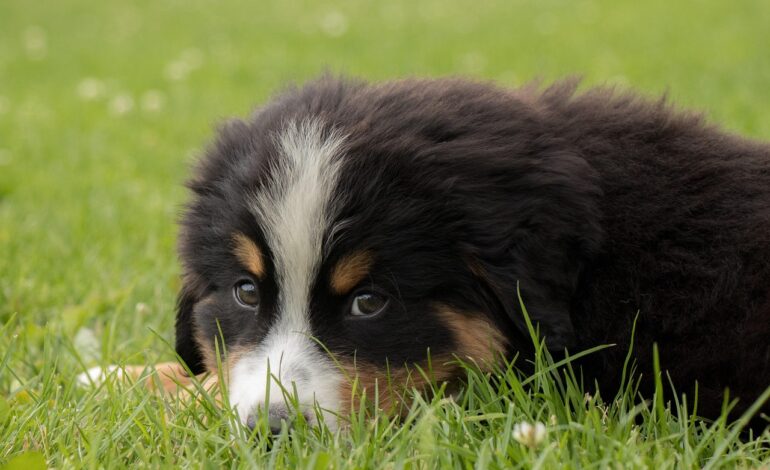
A Bernedoodle puppy looks like a teddy bear that learned to follow you from room to room. Bernedoodle puppies pair the calm, loyal nature of the Bernese Mountain Dog with the smarts and low-shedding coat of the Poodle, and the result is a friendly, goofy companion that bonds tightly with its family. But don’t mistake them for a low-maintenance dog: they need regular grooming, patient training, and a breeder who health-tests the parents, and the price tag reflects all of that.
This guide walks you through what they really cost in the United States, how big they get, what their coats need, how to train and feed them, and the health problems worth watching for, so you can decide before you put down a deposit.
What Bernedoodle Puppies Are Really Like
A Bernedoodle is a deliberate cross between a Bernese Mountain Dog and a Poodle, and it isn’t recognized as a purebred by the American Kennel Club. A puppy can take after either parent in looks, coat, and temperament.
Most Bernedoodle puppies are affectionate, playful, and gentle, with the Bernese side bringing easygoing loyalty and the Poodle side bringing quick intelligence. Many owners describe them as clownish, and large ones often seem unaware of their own size. They want to be near their people, and they do best in a home where someone is around for most of the day.
Two traits are worth knowing before you buy. First, the Bernese side can bring a stubborn streak: these puppies are smart, but they can be slow to respond when they’d rather be doing something else. Second, some are sensitive or reserved around strangers, which makes early socialization especially important. They also mature slowly, and standards can stay puppyish until they’re two or even three years old.
Bernedoodle Sizes: Standard, Mini, and Tiny
Size is the first decision most buyers make, and it comes down to the Poodle parent. A Standard Poodle produces standards, while a Miniature or Toy Poodle produces minis and tinies. Puppies from the same litter can still vary a lot in adult size, so ask the breeder how big the parents and earlier litters turned out.
| Size | Adult weight | Height at the shoulder |
|---|---|---|
| Tiny (or toy) | 10 to 24 pounds | 12 to 17 inches |
| Mini | 25 to 49 pounds | 18 to 22 inches |
| Standard | 70 to 90 pounds | 23 to 29 inches |
How Much Bernedoodle Puppies Cost in the USA
From a reputable breeder in the United States, Bernedoodle puppies usually run $2,000 to $5,000, with the national average close to $3,000. Smaller sizes and classic tricolor markings sit at the top of that range, and rare colors or tiny sizes can push the price past $8,000. Prices under $1,500 are a red flag, because responsible breeding costs real money in health testing, vet care, and socialization.
| Size | Typical puppy price |
|---|---|
| Standard | $2,000 to $4,000 |
| Mini | $3,000 to $5,000 |
| Tiny (or toy) | $3,500 to $8,000 or more |
The smallest dogs cost the most. Producing a mini or tiny means breeding down through smaller Poodles over several generations, and small litters are common at the tiny end of the scale.
What you’re paying for with a good breeder isn’t just the puppy. A quality breeder screens both parents for hip and elbow dysplasia, heart problems, and genetic conditions, and registers the results with the Orthopedic Foundation for Animals. They provide a health guarantee, first vaccinations, deworming, and often a microchip.
The purchase price is just the start. Budget roughly $3,500 to $5,000 for the first year once you add supplies, initial vet care, and grooming, and plan on roughly $2,000 to $3,500 a year after that, with grooming and food as the two biggest recurring costs. Going through a rescue is far cheaper, with fees typically $300 to $700.
A price way below the usual range, a seller who won’t let you meet the mother, many litters at once, puppies sold before eight weeks old, or a promise of a “non-shedding” puppy — all are reasons to walk away.
Bernedoodle Generations: F1, F1B, and Multigen
The generation tells you how the cross was made, and it mostly affects the coat and how much the puppy sheds.
An F1 is a first-generation cross, a purebred Bernese Mountain Dog bred to a purebred Poodle, about half and half. F1 puppies usually have a wavy coat, and shedding varies. Some shed noticeably.
An F1B is an F1 bred back to a Poodle, so about 75 percent Poodle. F1B puppies are more likely to have a curlier, lower-shedding coat, so many allergy-conscious buyers choose them, and they usually carry a premium price tag.
Bringing Your Bernedoodle Puppy Home
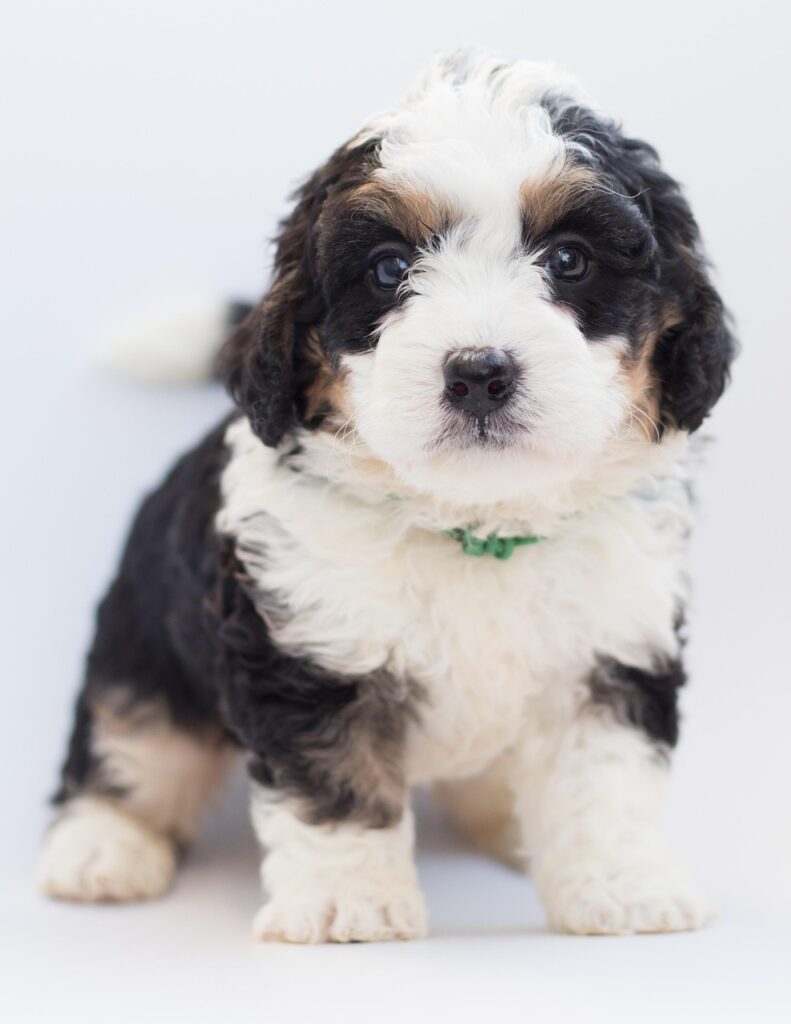
Most puppies go to their new homes at about eight weeks old. The first week sets the pattern for everything that follows, so it’s worth getting ready before your puppy arrives.
Puppy-proof the house first: move cords out of reach, remove toxic plants, lock up cleaning products, and put away anything chewable. Set up a crate in a quiet corner with a comfortable bed inside and the door left open. For a standard, buy a crate sized for the adult dog so you don’t have to replace it in a few months.
Keep the first few days calm. Let the puppy meet the family one person at a time, show it where to sleep, eat, and go potty, and stick to the same routine from day one. Puppies under twelve weeks old can’t hold their bladder for long, so plan potty breaks every couple of hours, including once during the night.
Book a vet visit within the first few days. Your veterinarian will give the puppy a once-over, confirm the vaccinations, schedule the next ones, and talk about deworming and flea and tick prevention. Bring the breeder’s paperwork, including the vaccination record. If it’s an emergency, our guide to emergency vets explains when to go and what to expect.
Feeding Your Bernedoodle Puppy
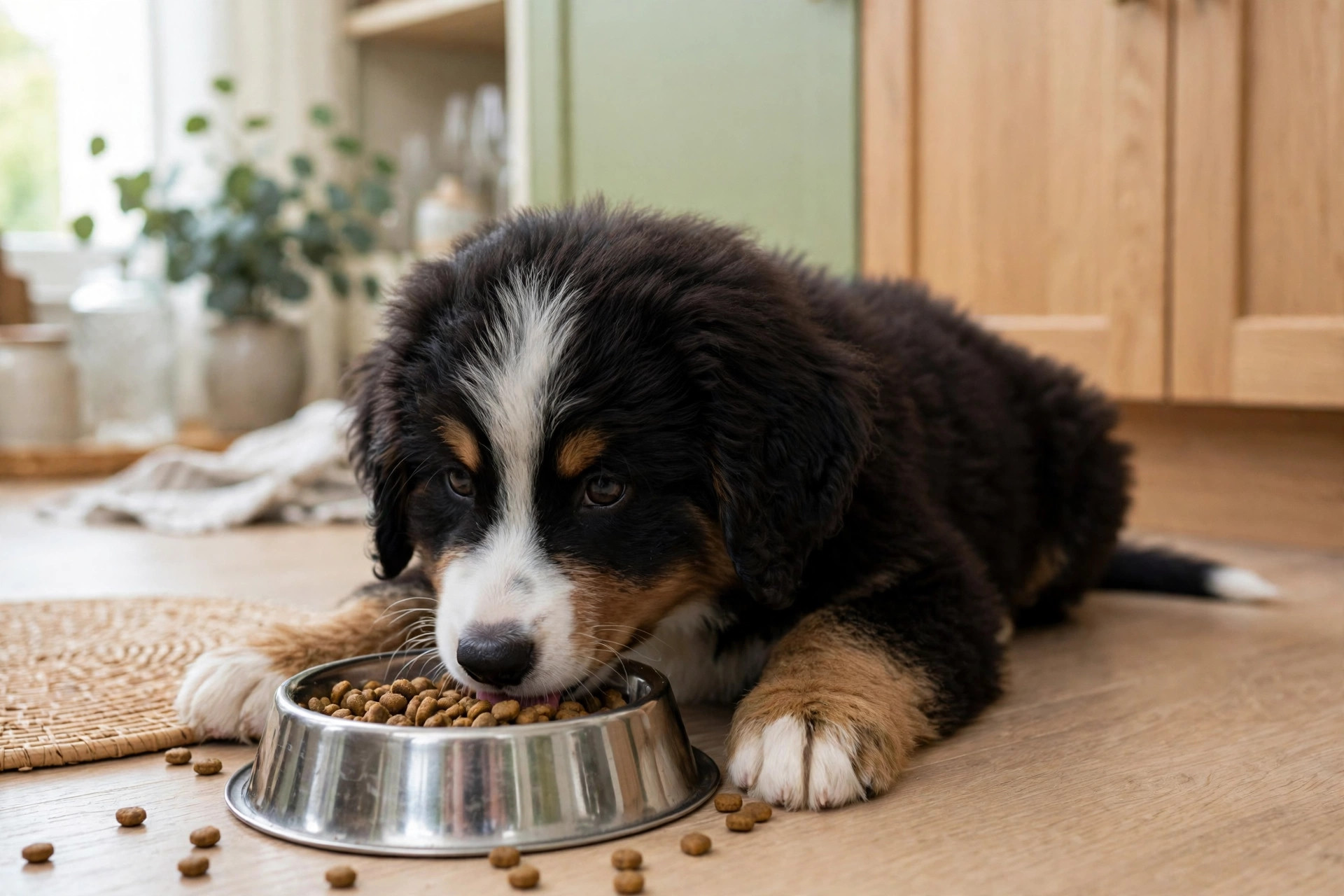
These puppies grow fast, and their food needs to support steady growth rather than maximum speed. Feed a puppy food made for the size your puppy will grow into: a standard needs a large-breed puppy food, because it’s balanced for the slower, steadier growth that protects developing joints, while a mini or tiny needs a food suited to its smaller size. Your veterinarian can confirm the right pick.
Young puppies usually eat three or four small meals a day, then move to two meals a day by about six months. Use the feeding guide on the food bag as a starting point, then adjust with your veterinarian’s help. Keeping a puppy lean matters more than usual, given the joint risks on both sides of the family.
Fresh water should always be available. Treats are fine for training, but keep them small and count them toward the day’s food. Never feed cooked bones, chocolate, grapes, raisins, onions, or xylitol; all are dangerous for dogs.
Large, deep-chested dogs are also at risk of bloat, where the stomach fills with gas and twists. It’s a serious emergency: a swollen belly, restlessness, and unproductive retching mean a vet visit right away.
Training and Socializing Your Bernedoodle Puppy
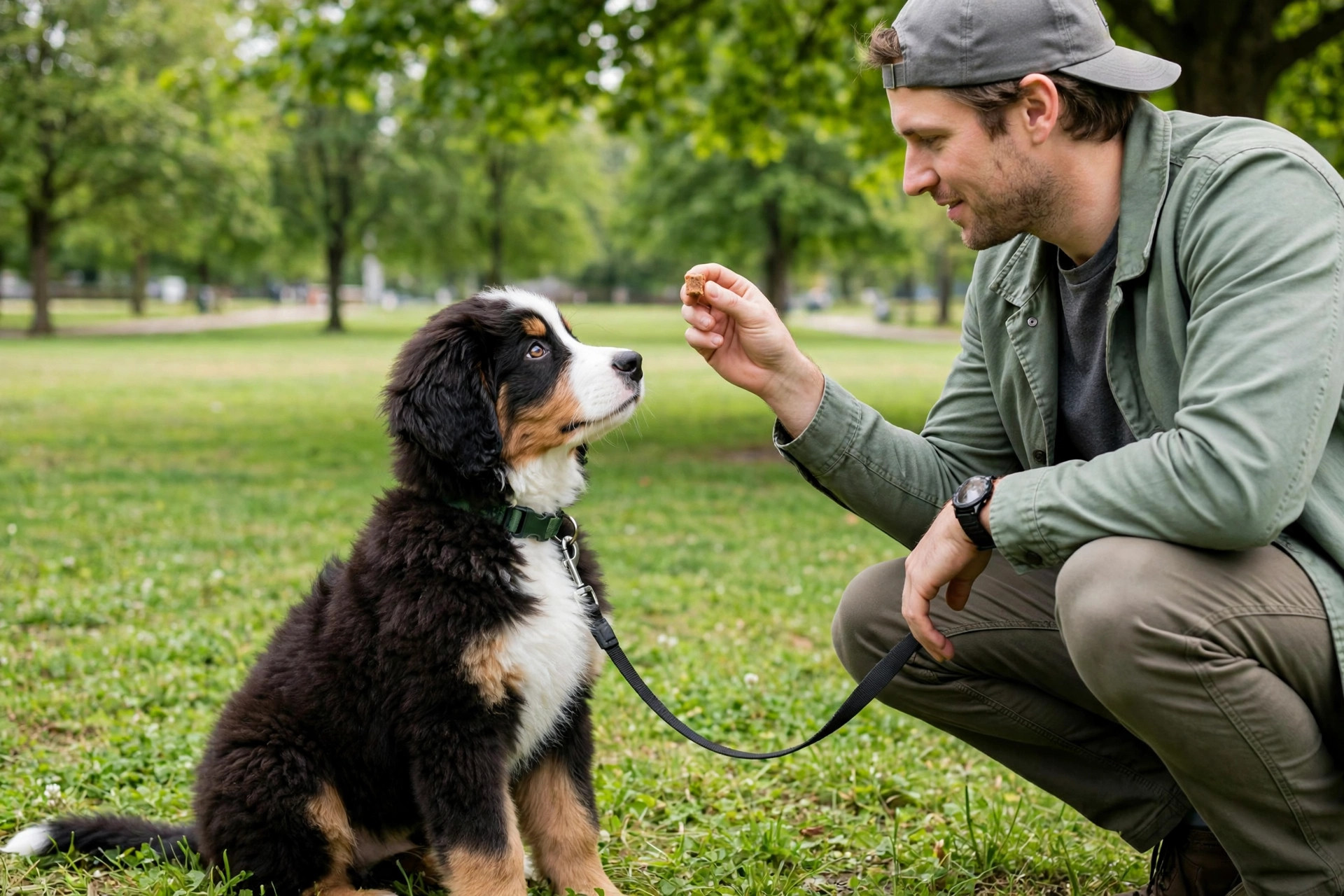
Training can start the day your puppy comes home. Puppies can learn their name, “sit,” and “come” from eight weeks old, and short, upbeat sessions work far better than long, strict ones. Keep each session to five or ten minutes, use small treats and plenty of praise, and end while your puppy is still having fun.
These puppies respond best to short, upbeat, reward-based training, and they can shut down with harsh corrections. Because they’re sensitive, harsh methods can lead to anxiety and resistance, so patience isn’t optional. Mental stimulation helps with the stubborn streak, too — a puppy that’s had a good sniffy walk and a food puzzle is usually much more willing to listen.
The socialization window is the most important part of raising one. Before 16 weeks, give your puppy plenty of calm, positive exposure to different people, children, friendly vaccinated dogs, car rides, and new sounds — always at the puppy’s pace. A puppy that meets the world calmly in those early weeks is far more likely to grow into a confident adult.
Crate training and house training go together. Take your puppy out first thing in the morning, after meals, after play, and before bed, and praise it warmly when it goes outside. Our step-by-step guide to potty training a puppy covers the routine in full. Leash manners matter early too, before a standard outweighs you, and so does gentle handling of the paws, ears, and face, so grooming isn’t a battle later.
Exercise and Mental Work for Bernedoodle Puppies
Most adult Bernedoodles need moderate exercise, about 30 to 60 minutes a day. Minis and tinies often have more bounce, while standards are usually happy with walks and play. Puppies need less: short bursts of play, gentle walks, and training games suit a young puppy better than long runs, steep stairs, or repeated jumping, so avoid those until your veterinarian says the growth plates have closed.
Mental exercise matters just as much. Puzzle feeders, scent games, and short training sessions tire a puppy out in the best way, and a bored puppy will find its own entertainment — usually chewing furniture or digging. A securely fenced yard helps, but it’s no substitute for walks and training. If you’re thinking about how to keep a dog safely in your yard, see our guide to the invisible fence for dogs. Thick coats also make them prone to overheating, so keep summer exercise to the cooler parts of the day.
Grooming Bernedoodle Puppies and Shedding
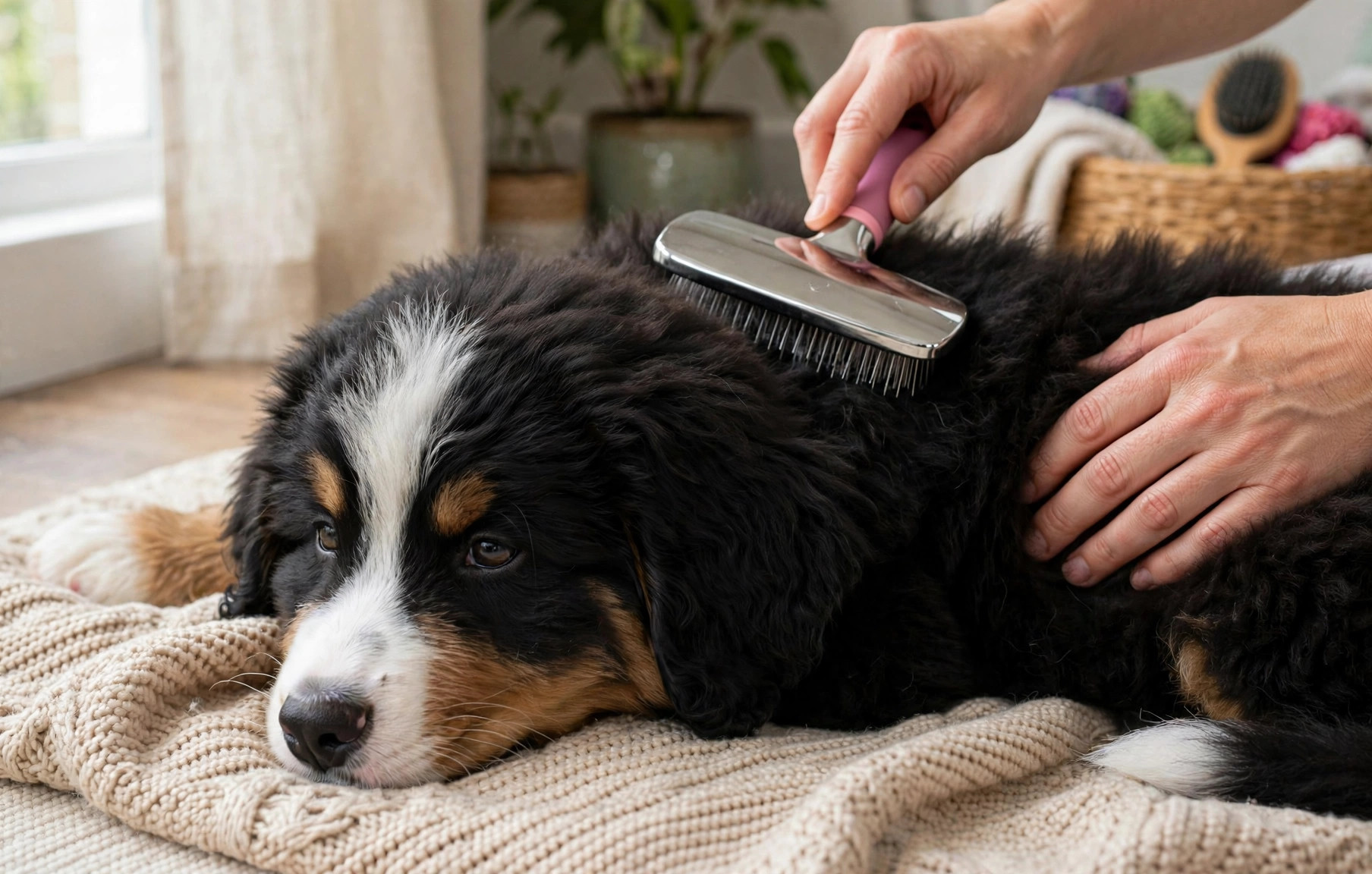
These puppies have one of the most demanding coats of any doodle cross. Their thick, wavy or curly coats mat fast, especially behind the ears, under the collar, and around the legs. Skip the routine and you’ll get painful mats that often force a full shave-down at the groomer.
Coat type decides shedding and brushing. A curly coat sheds the least but needs the most grooming. A wavy coat, the typical look, sheds moderately. A straight coat sheds most and is least predictable in a first-generation puppy.
Brush three or four times a week at minimum, often daily for curly coats, using a slicker brush and a metal comb worked down to the skin. Professional grooming is needed every six to eight weeks, typically $70 to $120 for tinies and minis and $100 to $175 for standards. Check the ears weekly, because floppy ears trap moisture.
Are they hypoallergenic? No dog is truly hypoallergenic. Lower shedding means less hair and dander on your floors, which may help some allergy sufferers, but allergens come from dander and saliva too, so reactions vary from person to person. If allergies are the reason you want one, spend time with the puppy and its parents first, and don’t trust a breeder who promises you a hypoallergenic dog.
Health Problems to Watch For
These puppies can inherit health problems from either side of the family, and a responsible breeder health-tests the parents to lower that risk. The tests worth asking about are hip and elbow screening, a cardiac exam, an annual eye exam, and DNA tests for degenerative myelopathy, von Willebrand disease, and progressive retinal atrophy.
From the Bernese side, the main risks are cancers, especially histiocytic sarcoma, along with hip and elbow dysplasia, degenerative myelopathy, von Willebrand disease, and bloat. From the Poodle side, the risks include hip dysplasia, Addison’s disease, progressive retinal atrophy, and patellar luxation in mini and toy lines. Eye problems and skin allergies are also common.
Bernedoodles typically live about 9 to 14 years, with tiny and mini sizes often at the longer end and standards at the shorter end. That’s well beyond the purebred Bernese Mountain Dog’s typical 7 to 10 years, but the Bernese health risks don’t disappear in the cross.
This article is general information, not veterinary advice. Your veterinarian knows your puppy’s history and your local risks, and that’s who should make the final call on food, vaccines, and any health concern.
Bernedoodles and Families
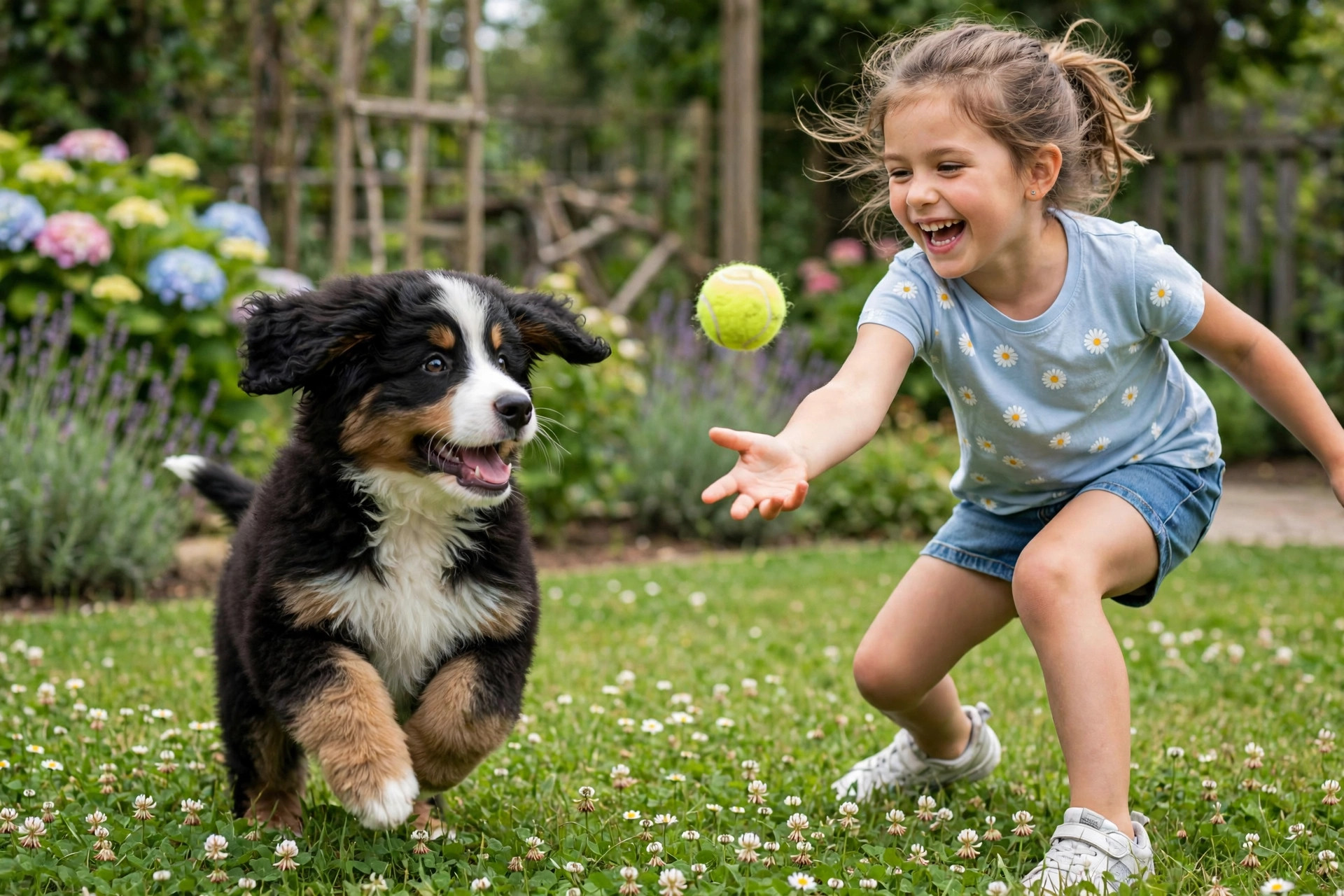
Bernedoodle puppies can be wonderful family dogs, and they’re often patient and gentle with the kids they grow up with. The key is supervision and teaching: kids should treat the puppy gently, leave it alone while it eats and sleeps, and never tease it. A young standard can knock a small child over by accident, so watch playtime closely.
Buying or Adopting a Bernedoodle Puppy
If you decide to buy, look for a breeder who health-tests both parents, raises the puppies in the home, and asks you plenty of questions about your life. A good breeder will show you the health clearances, let you meet the mother, and stay in touch after you bring the puppy home. Be ready to join a waitlist, especially for a tricolor mini, where demand runs high.
If you decide to adopt, contact a doodle rescue or your local shelter. Rescues often have these puppies as well as adults, and they can tell you about each dog’s temperament based on foster care. Adoption costs far less, with rescue fees typically $300 to $700. Either route can bring you a wonderful companion, as long as you choose carefully.
Frequently Asked Questions
How much do Bernedoodle puppies cost?
From a reputable breeder, they usually cost $2,000 to $5,000, with the national average close to $3,000. Standards usually run $2,000 to $4,000, minis $3,000 to $5,000, and tiny ones $3,500 to $8,000 or more. Adoption usually costs $300 to $700. Prices vary by region, size, color, and bloodline, so confirm the full cost before you decide.
How big do Bernedoodle puppies get?
It depends on the Poodle parent. Tiny ones grow to about 10 to 24 pounds, minis to about 25 to 49 pounds, and standards to about 70 to 90 pounds. Puppies from the same litter can vary a lot, so ask the breeder how big the parents and earlier litters turned out.
Are Bernedoodle puppies hypoallergenic?
No. No dog is truly hypoallergenic, because allergies are triggered by dander and saliva proteins, not fur alone. Puppies with curly, Poodle-like coats shed least, especially F1B puppies, which may cause fewer symptoms for some people, but spend time with the dog first if allergies matter to you.
Do Bernedoodle puppies shed a lot?
Most shed lightly, but it depends on the coat. F1B and multigen puppies with curly coats usually shed least, while F1 and F2 puppies can shed more. Their thick coats need frequent brushing either way, and a straight-coated puppy can shed noticeably.
How long do Bernedoodle puppies live?
Most Bernedoodle puppies live about 9 to 14 years, longer than purebred Bernese Mountain Dogs. Smaller ones tend to live longer than standards, which are usually at the shorter end of that range.
Are Bernedoodle puppies hard to train?
They’re smart but can be stubborn and sensitive, so they’re not the easiest first dog. Short, positive training sessions and early socialization work best, and harsh corrections can make them shut down. They often take longer to mature than other doodles.
The Bottom Line
Bernedoodle puppies aren’t an easy first dog, and they’re not a cheap one either. They’re smart, loyal, and eager to be near you, and they grow into gentle, devoted adults when they get early training, careful socialization, and enough exercise and mental work. But they also need brushing several times a week, professional grooming every six to eight weeks, and a breeder who health-tests the parents.
Before you bring one home, be honest about the cost, the grooming, the training time, and the years of commitment ahead. Choose carefully, from health-tested parents or a trusted rescue, and start training and socializing from day one.